
Core Technologies
This section covers the fundamental SDVoE technologies that enable DisplayNet's professional AV-over-IP capabilities.
Synchronous Data Delivery
Video and audio signals are traditionally synchronous data streams, which means that each bit of information must arrive from source to destination sequentially and at the correct rate. If this sequence or rate is compromised, signal distortions or signal failure is likely to occur. Ethernet is an asynchronous medium and complex techniques often employed to guarantee synchronous data delivery over an asynchronous network. IEEE 1588 PTP (Precision Time Protocol) is one of these techniques. While 1588 PTP is very accurate, it has one substantial drawback; it requires special 1588 PTP or AVB (Audio Video Bridging) enabled switches. These switches are not only more expensive than normal switches, but model selection is also quite limited. DisplayNet utilizes specialized SDVoE technology called Adaptive Clock Resynchronization (ACR) to guarantee synchronous data delivery across asynchronous standard 10GbE networks. Unlike IEEE 1588 PTP, which only works with certain dedicated switch models, DisplayNet works with any standard 10GbE network switch provided the switch is a standard non-blocking switch with IGMP snooping enabled. This allows off-the-shelf 10GbE network switches to be leveraged for professional AV applications.
Packet size varies from 64 bytes to 1500 bytes. The standard packet size for DisplayNet is 1500 bytes, including 1440 bytes of payload. Smaller packets may need to be sent to complete a frame. Jumbo packets are never used.
10Gb AV-over-IP
Many conventional AV-over-IP solutions use 1GbE Ethernet network switches to distribute AV signals. Due to the bandwidth requirements of high resolution signals, these systems must employ heavy traditional compression codecs to "fit" the signal into this limited (1 Gbps.) bandwidth. Compression signal processing can introduce loss of image quality, as well as a noticeable amount of signal latency (200-450 milliseconds is common). This fact makes traditional compressed solutions of limited value in many common professional AV applications.
The video feed could be noticeably out of sync with the live action of the performers. A person using a computer connected to a display with a traditional compression solution can notice a significant delay in keyboard and mouse response time, creating a degraded user experience on a daily basis. When considered carefully, this combination of increased latency and reduction in image quality may be unacceptable in professional AV applications.
DisplayNet leverages the greater bandwidth of 10GbE networking to transport high resolution video in up to 4K (UHD) without the use of compression codecs. In Genlocked Mode, DisplayNet can distribute a 4K /30p resolution signal with a maximum latency of 30 microseconds, which is far less than 1 frame of video, and is undetectable by the human eye.
In order to meet the bandwidth requirements for 4K60 video, the DN-300 series employs a hardware-based proprietary light compression algorithm. Unlike traditional compression algorithms, the compression algorithm employed in the DN-300 series is very light, with a 1.4 to 1 compression ratio, whereas the highest-quality competing standard runs at a 8 to 1 compression ratio. This lower compression ratio allows DisplayNet to achieve the highest-quality image among all other AV-over-IP standards, while maintaining zero-frame latency (100 microseconds maximum in Genlocked Mode). With compression enabled, the difference between the source image and the compressed destination image is visually imperceptible and completely artifact-free. For these and other reasons, DisplayNet is the ideal solution for signal distribution applications that cannot be compromised by latency and image quality losses. The following table shows a comparison between DisplayNet and common compression codecs:
| DisplayNet DN-300 | VC-2 | MJPEG 2000 | H.264 / H.265 | |
|---|---|---|---|---|
| Typical Latency | 0 frames (in Genlocked Mode) | 0.5 frames | 6 frames | 15 frames |
| Typical Compression | 1.4 to 1 | 8 to 1 | 10 to 1 | 200 to 1 |
| Multi-layer Routing | Yes | No | No | No |
| Optimized for | Pro AV | Broadcast | Digital Cinema | Mobile Streaming |
Bandwidth Usage
DisplayNet utilizes the bandwidth of 10Gb Ethernet to support multiple signal types over a single connection.
A 4K /30p (8-bit, 4:4:4) HDMI signal with embedded audio usually occupies ~8.91 Gbps. (2.97 Gbps. per color) of bandwidth.
To allow for sufficient overhead for multiple datastreams, DisplayNet utilizes SDVoE ACR technology to synchronize video signals sent using the 10GbE connection, rather than HDMI's integrated TMDS synchronization signal. The TMDS component of the HDMI signal (which uses 2.27Gb of bandwidth alone) is discarded by the transmitter, and ACR reconstructs it on the receiver. The result is that the required bandwidth for a 4K /30p video signal is reduced to ~6.7 Gbps, which allows for more than 30% headroom to support other signals. The remaining bandwidth may be used for 1GbE traffic, External Analog Audio, Downmixed Audio, RS-232, and bidirectional IR signals.
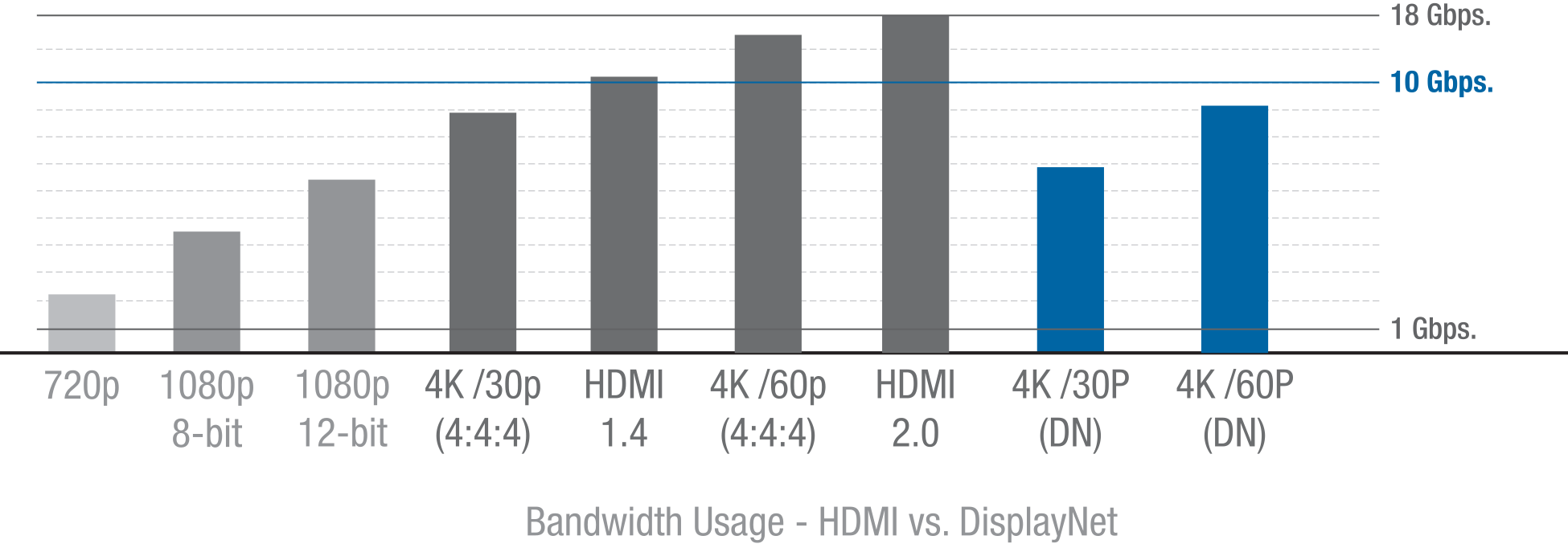
For 4K60 signals, light compression (with a ratio of 1.4 to 1) is applied to the video signal. In combination with ACR, this reduces the bandwidth used by a 4K (UHD) 60hz 4:4:4: signal to approximately 9Gbps, allowing for the transmission of 4K60 content over 10Gb Ethernet. Video sent with this compression is visually indistinguishable when compared to the source signal, with a latency of approximately 100 microseconds in Genlocked Mode.
For AV applications, it is important to design and configure networks to avoid oversubscription. In IT applications, oversubscription is a normal event that occurs when a network, port or switch has more incoming traffic than outgoing bandwidth available. Oversubscription occurs when the network is temporarily and suddenly burdened with large amounts of bursty traffic. In typical IT network applications, switches can easily tolerate bursty traffic and typically operate with a 3 to 1 oversubscription ratio. However, due to the sustained high bandwidth use and low latency requirements of AV applications, oversubscription must be avoided at all costs when designing and deploying networks intended for use with DisplayNet.
One way to avoid issues with oversubscription is to use a non-blocking network switch to ensure that full-duplex 10GbE data transfer capacity is available for each port. When oversubscription occurs on a blocking switch, traffic is blocked or stalled, and the network switch is unable to forward all of the traffic. A blocking switch will queue up the data to be sent at a later time, which is expected behavior in a network used for traditional IT applications. For AV, network traffic must be delivered synchronously so that it is never queued up or stalled. Stalled AV traffic can cause picture problems or image failure. For this reason, a non-blocking switch must be used and the network must be configured so that oversubscription never occurs. Consult with DVIGear technical support or a qualified IT specialist for a full discussion on network traffic management.
When designing a DisplayNet system, it is important to keep in mind the total bandwidth consumed by the HDMI streams that are to be routed to any individual receiver. Certain configurations, especially when using Multiview, may cause oversubscription. Additionally, the use of the 1GbE and USB ports may interrupt the video stream at higher resolutions. DisplayNet Manager includes tools to assist with bandwidth planning. Careful planning of bandwidth usage is needed to mitigate this risk.